Downloads

More theoretical and practical information and applications of CALCut in papers and videos on laser cutting.

CALCut is a model and simulation tool for optimizing laser cutting efficiency and quality.


Learn more about the theoretical CALCut laser beam cutting model and comprehensive practical verification of CALCut simulation results (PDF)

Find out contributions of CALCut to the theoretical understanding of fiber laser cutting and the practical effect of 1 micron wavelength on cutting speed and cut quality (PDF)

See further explanation by CALCut about the physics of the laser beam cutting process (PDF)

CALCut calculates laser beam cutting 10mm thick tungsten tiles for a Nuclear Fusion Reactor – YouTube

CALCut simulates impact of 300kW laser beam on drone in 1km distance – YouTube

Some additional videos:

Milestones of laser beam cutting, and a look ahead – YouTube

Seeing is believing – Some new insight into laser beam welding and cutting processes – YouTube

And here you find more than 100 papers and other publications:
Dirk Petring on ResearchGate

CALCut_Background_bw Downloads

CALCut is a model and simulation tool self-developed and privately owned by Dr. Dirk Petring since 1993. It has been used exclusively for Fraunhofer Institute for Laser Technology ILT 1993-2023 where it has been verified and approved in numerous industrial projects.

Legal notice

DP_portraet_sw Legal notice


Dr. rer. nat.
Dirk Petring

c/o Fraunhofer ILT
Steinbachstr. 15
52074 Aachen
Germany

Tel. +49 162 49 162 01
contact@calcut.de
www.calcut.de

.

Track record

1986

Establishment of the Cutting Group at Fraunhofer ILT

1987

Oxide-free and burr-free laser beam fusion cutting of up to 6 mm stainless steel

1988

Theory and practical verification of power balance and absorption distribution

1988

Schlieren-diagnostic identification of supersonic effects within cut kerfs

1989

Oxide-free and burr-free laser beam fusion cutting of up to 15 mm stainless steel

1989

Promotion of the Cutting Group to the Department Cutting

1991

Laboratory prototype of a laser slitting line with 2 lasers and cutting heads (GEORG)

1991

Laser slitting of 0.27 mm thick electrical steel with 100 m/min (THYSSEN)

1991

Laser machining of steel cavities by Lasercaving (MAHO)

1993

Industrial laser beam fusion cutting up to 18mm stainless steel (THYSSEN)

1993

Completion of CALCut as steady-state 3D-model and simulation of laser cutting

1993

Submission of the PhD dissertation “Application oriented modelling of laser beam cutting for computer aided process optimization“ (in German)

1994

Invention of the Autonomous Nozzle

1995

PhD certificate from the RWTH Aachen University

1996

Laser beam cutting and welding of steel plates at German shipyard (Blohm+Voss)

1996

Laser beam fusion cutting of 40 mm stainless steel plates for the ITER project

1996

Invention of laser process closed-loop control by modulation response signals

1998

Industrial pilot line of a laser slitting line with 8 lasers and cutting heads (GEORG)

1998

Expansion of the Department Cutting to the Department Cutting & Joining

1999

Deep penetration welding of steel with diode laser (DILAS)

2001

Laser-GMA butt-joint hybrid welding of 15 mm mild steel in a single pass

2002

Lloyd’s Register Certification laser-GMA hybrid welding stainless steel tubes (RIVIT)

2002

Invention closed-loop controlled synchronized modulation of laser-arc hybrid welding

2006

Industrial implementation of laser combi-head for cutting and welding (LASERFACT)

2008

Explanation of the thermodynamics of the oxidation reaction in laser-oxygen cutting

2008

High-speed cutting 1mm UHS steel with 4 kW fiber laser at 100 m/min (HONDA)

2010

Downsizing of the Department to the Group Macro-Joining & Cutting

2012

Clarification of peculiarities of the fiber laser cutting process

2013

Multi-pass scan strategy to minimize thermal damage in laser cutting of composites

2017

In-situ-visualization of multiple reflections on the cut flank during fiber laser cutting

2019

Invention of the laser cutting whistle

2023

Optical cutting process control via AI-inferencing with classification accuracy 0.98

2023

Split-up and handover of the Group Macro-Joining & Cutting in two separate units

CALCut is a model and simulation tool self-developed and privately owned by Dr. Dirk Petring since 1993. It has been used exclusively for Fraunhofer Institute for Laser Technology ILT 1993-2023 where it has been verified and approved in numerous industrial projects.

Simulation

CALCut uses a clever combination of semi-analytical and semi-numerical algorithms to calculate the laser cutting process.

CALCut is a model and simulation tool for optimizing laser cutting efficiency and quality.

In the steady-state equilibrium, the cutting front arises in such a way that the locally absorbed power density corresponds to the local heat-flow requirement. Beside the power balance, mass and force balance have to be fulfilled simultaneously.

The above mentioned power, mass and force balances and a boundary layer approximation of the heat flow at the flank as well as two continuity conditions for vertex and flank provide the governing equations to be solved for the calculation of each segment.

A CALCut run starts with the parameter setup. Then CALCut visualizes the resulting focus caustic with isophotes and allows for iterative correction of beam parameters. Next, the operator selects the subsequent calculation procedure (v, vmax, SR, MR). Finally cutting front and cut kerf are calculated and visualized, including a 3D view with distribution functions and a listing of various process performance indicators.

CALCCut_Flowchart Simulation
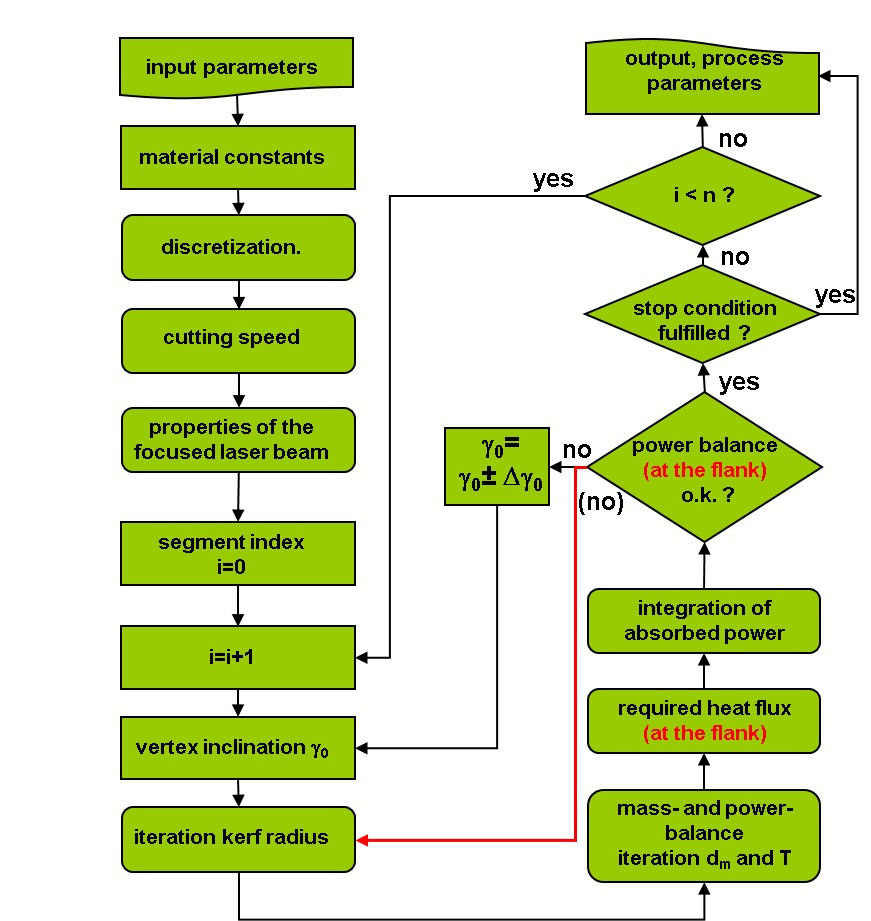
Flowchart of the CALCut simulation tool.
The video shows the complete course of a CALCut run. CALCut calculates how a 20 kW Fiber Laser Beam could cut 10mm thick tungsten tiles of a Nuclear Fusion Reactor. Tungsten is the perfect material for shielding plasma-facing walls against high heat, ion and neutron fluxes.

CALCut is a model and simulation tool self-developed and privately owned by Dr. Dirk Petring since 1993. It has been used exclusively for Fraunhofer Institute for Laser Technology ILT 1993-2023 where it has been verified and approved in numerous industrial projects.

Output

Proven outcome of CALCut simulations: Instructive laser cutting front representations and unique correspondence with practice.

CALCut is a model and simulation tool for optimizing laser cutting efficiency and quality.

The unprecedented scope of the physical sub-processes included in CALCut enables the three-dimensional stationary cutting front geometry and the resulting cut kerf geometry to be calculated theoretically.

CALCut identifies the spatial distributions of the absorbed laser beam power density, of the temperature, of thickness and flow velocity of the melt film along with the evaporation rates and pressure gradients.

The analysis of the cutting front geometry and the above mentioned distribution functions allows conclusions to be drawn about the practically achievable cut quality.

An automatic iteration feature of CALCut can determine the highest possible cutting speed achievable with the selected input parameters in practice.

Proven-CALCut-calculations-LAMP2009 Output
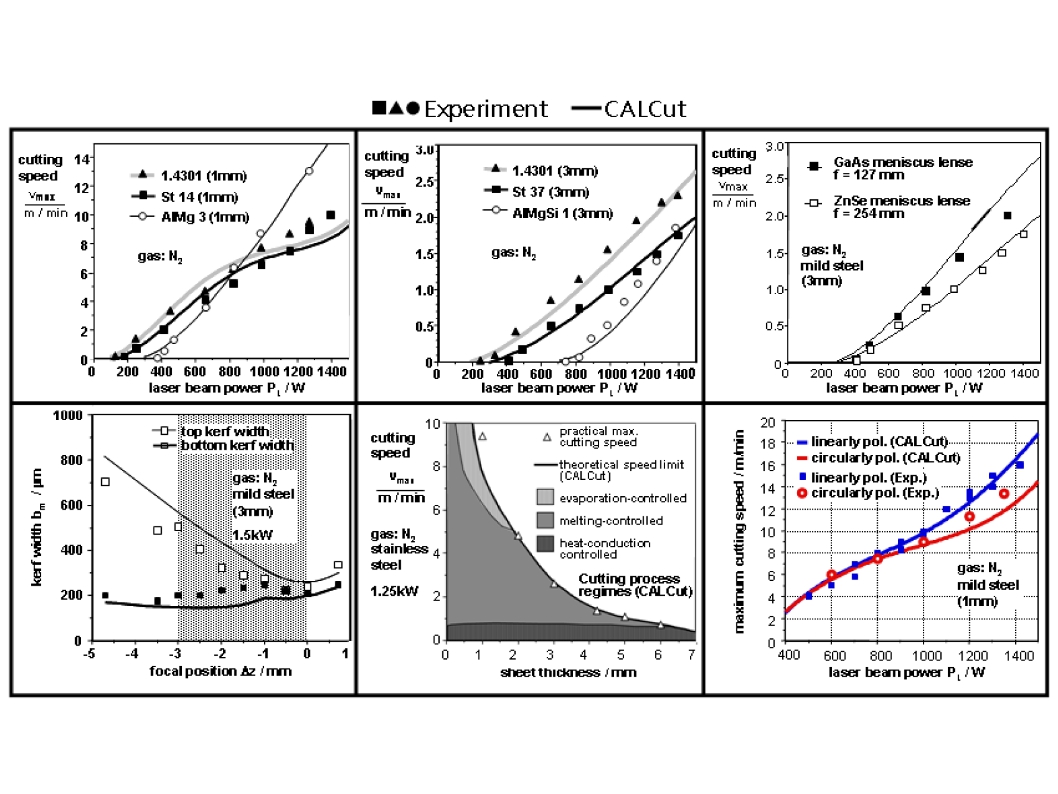
Proven correspondence of the results from the computer simulation CALCut (lines) and the practical outcome (symbols) regarding the influence of material, sheet thickness, laser beam power, cutting speed, focal length, focal position and polarisation in case of CO2 laser cutting. Three process regimes have been identified.
CALCut calculation sequence of a cutting front.
CALCutFronts1u Output
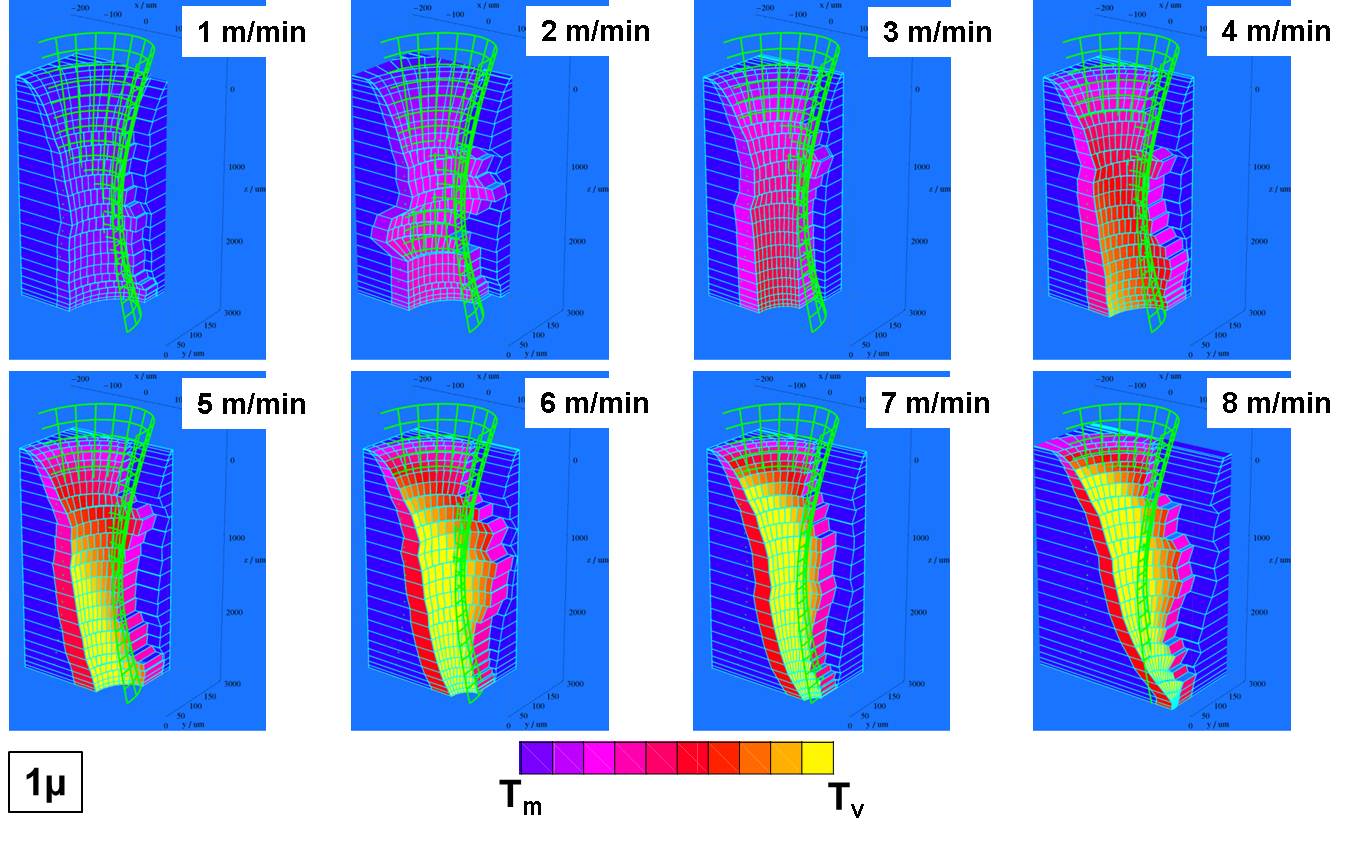
Laser beam cutting fronts calculated by CALCut for fiber laser cutting 3mm stainless steel at varied speed.

CALCut is a model and simulation tool self-developed and privately owned by Dr. Dirk Petring since 1993. It has been used exclusively for Fraunhofer Institute for Laser Technology ILT 1993-2023 where it has been verified and approved in numerous industrial projects.

Input

Extensive consideration of laser cutting parameters by CALCut.

CALCut is a model and simulation tool for optimizing laser cutting efficiency and quality.

CALCut takes into account the material, material thickness, laser wavelength, beam quality, beam power and power density distribution, polarization, raw beam diameter, focusing optics, focal length, focal position, cutting gas type and pressure as well as the cutting speed.

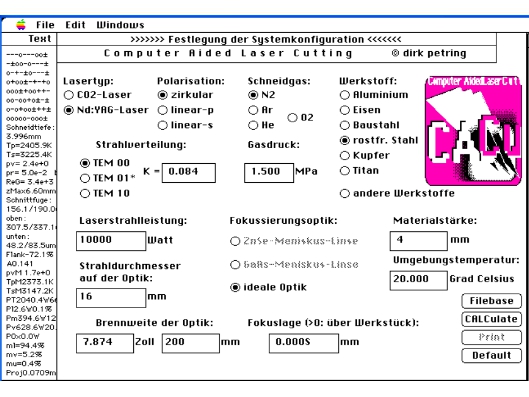
CALCut_Systemkonfiguration Input
The parameter input screen represents workpiece, system setup and its adjustment.

Thus, all relevant beam, gas, material and machine parameters are considered in model and simulation. The input can be carried out very comfortable on the start screen.

CALCut is a model and simulation tool self-developed and privately owned by Dr. Dirk Petring since 1993. It has been used exclusively for Fraunhofer Institute for Laser Technology ILT 1993-2023 where it has been verified and approved in numerous industrial projects.

Model

The CALCut model profits from a sophisticated parameterization of the laser cutting front.

CALCut is a model and simulation tool for optimizing laser cutting efficiency and quality.

The unprecedented scope of the physical sub-processes included in CALCut enables the three-dimensional stationary cutting front geometry and the resulting cut kerf geometry to be calculated.

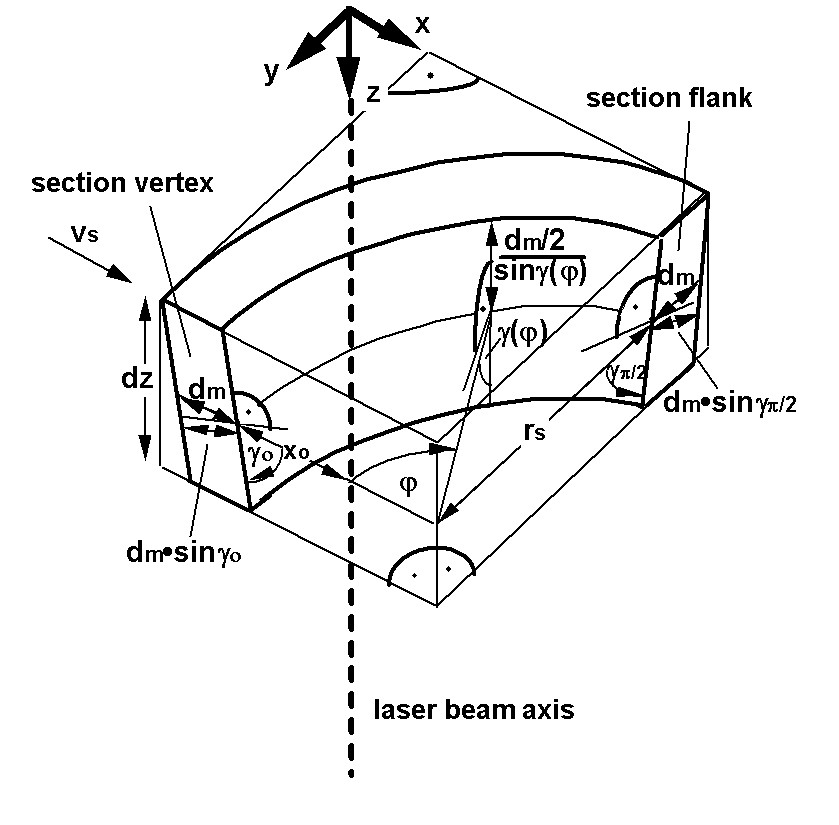
The parameterization of the laser cutting front is based on vertically stacked, semicircular cutting front segments of defined height being horizontally resolved by discrete facets. The shape and position of every single segment is parameterized by its height, curvature radius, melt film thickness, vertex and flank inclinations and its horizontal distance from the laser beam axis in cutting direction.

In a closed formulation, the three-dimensional, steady-state model links the sub-processes of beam focusing, beam propagation, Fresnel absorption and reflection, compressible cutting gas flow, exothermic reaction (when indicated), heat conduction, phase transformation into the molten and vaporous states and mass transport due to melt and vapor flows taking into account the shear-stress induced by the cutting gas flow, capillary forces due to surface tension and driving forces due to vapor pressure gradients.

The viscous melt is treated as a Newtonian fluid. The cutting gas flow is modelled as a function of the cutting gas type and the cutting gas pressure and depends on the geometry and temperature of cutting front and kerf.

CALCut_Model Model
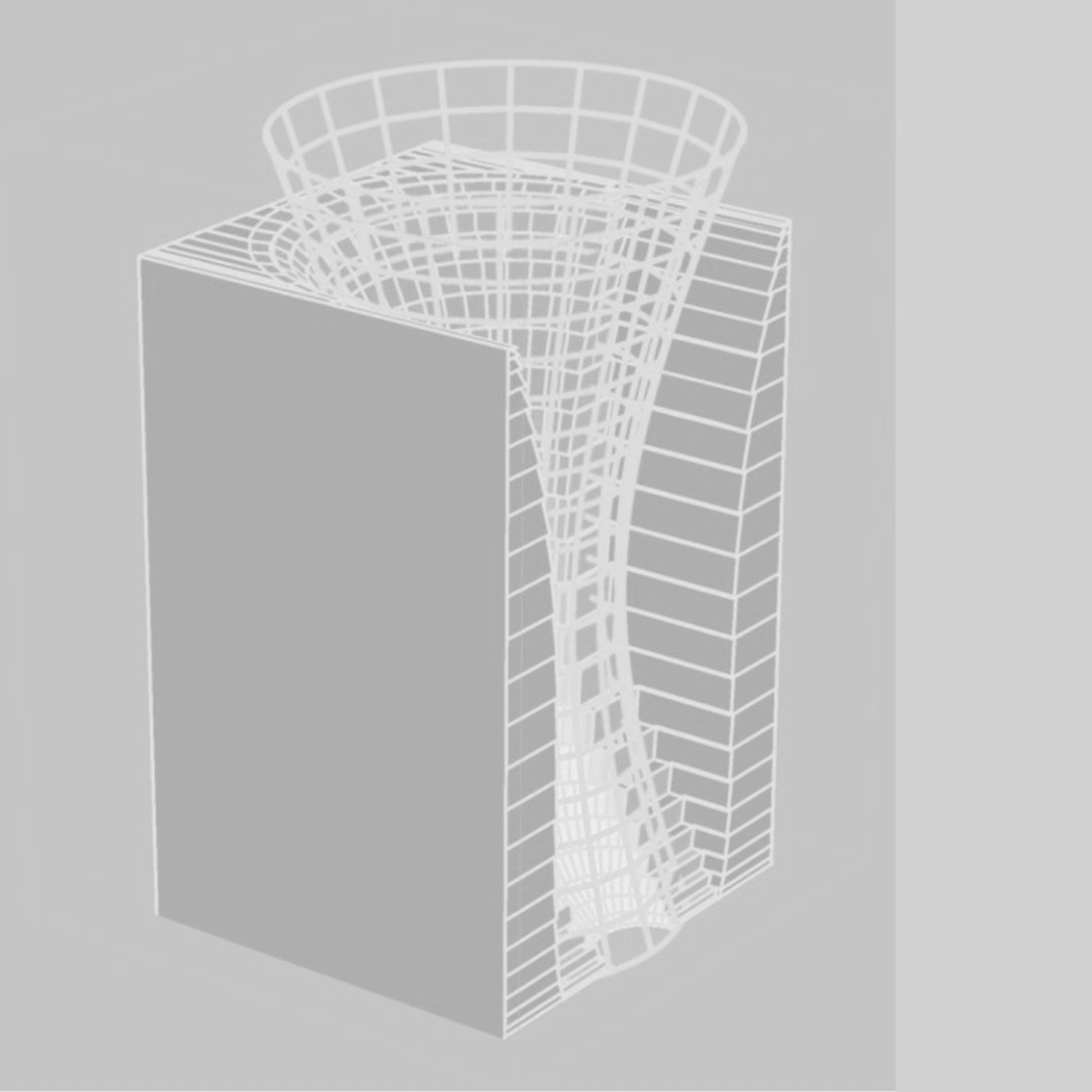
The geometry of the laser cutting front calculated by CALCut is based on well-defined vertically stacked semicircular segments.

Below the nozzle exit, the gas jet is assumed to initially expand isentropicly and subsequently, via a normal compression shock above the workpiece, experiences an increase in entropy. This is taken into account as a loss in static pressure before the second isentropic expansion in the kerf. The resulting flow rate in the kerf is calculated. The locally induced shear stress is estimated according to the laws of turbulent channel flow. The maximum penetration depth of the supersonic flow field – here called “maximum jet penetration” – is determined by calculating the flow distance where the highest physically allowable pressure increase due to the friction losses occurs. This part of the model makes use of the conservation equations for compressible tubular flow in isothermal approximation.

In the steady-state equilibrium, the laser cutting front calculated arises in such a way that the locally absorbed power density corresponds to the local heat-flow requirement. Beside the power balance, mass and force balance are fulfilled simultaneously in the CALCut model and simulation.

CALCut is a model and simulation tool self-developed and privately owned by Dr. Dirk Petring since 1993. It has been used exclusively for Fraunhofer Institute for Laser Technology ILT 1993-2023 where it has been verified and approved in numerous industrial projects.

Privacy Policy

Who we are.

Our website address is: https://www.calcut.de. Further info please see Legal notice.

CALCut is a model and simulation tool self-developed and privately owned by Dr. Dirk Petring since 1993. It has been used exclusively for Fraunhofer Institute for Laser Technology ILT 1993-2023 where it has been verified and approved in numerous industrial projects.

Cookies

We only use cookies within the legally permitted scope. These are automatically deleted after you leave the site and do not require your consent. However, you can configure your browser so that no cookies are stored on your computer.

Data protection

We only collect data and save them in a way and for a time we are obliged to keep for administrative, legal, or security purposes.

The following is a list of data collected by web server logs in a log file. Their maximum storage period is 60 days, after which they are automatically deleted.
Stored are:

  • IP address of the requesting computer in anonymized form. This is used to determine the location of the access and is further anonymized after seven days. This means that it is only possible to trace the IP address back to the provider.
  • Date and time of access
  • Requested website or file
  • Website from which the access is made
  • Browser type and browser version
  • Operating system used

Below is a list of data collected through FTP logs. Their maximum storage period is 60 days, after which they are deleted.
Stored are:

  • IP address of the FTP user
  • FTP user name
  • Date and time of access

The data collection described above is carried out in the legitimate interest of ensuring a smooth connection setup of the website, ensuring its comfortable use, evaluating system security and stability, and for other administrative purposes. The legal basis is Art. 6 para. 1 p. 1 lit. f DSGVO. The aforementioned data is not used for the purpose of drawing conclusions about your person.

Embedded content from other websites

Articles on this site may include embedded content (e.g. videos, images, articles, etc.). Embedded content from other websites behaves in the exact same way as if the visitor has visited the other website.

These websites may collect data about you, use cookies, embed additional third-party tracking, and monitor your interaction with that embedded content, including tracking your interaction with the embedded content if you have an account and are logged in to that website.

What rights you have over your data

You can request that we erase any personal data we hold about you. This does not include any data we are obliged to keep for administrative, legal, or security purposes. Express reference is made to your rights according to Art. 12-23 DSGVO.