CALCut uses a clever combination of semi-analytical and semi-numerical algorithms to calculate the laser cutting process.
CALCut is a model and simulation tool for optimizing laser cutting efficiency and quality.
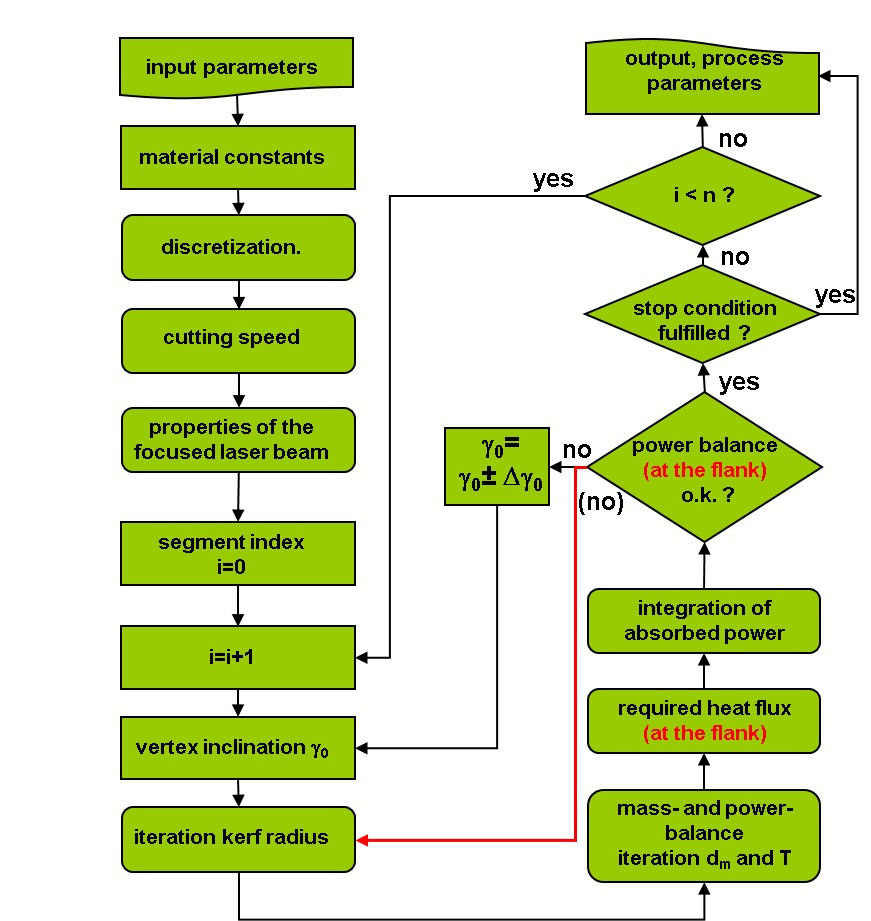
In the steady-state equilibrium, the cutting front arises in such a way that the locally absorbed power density corresponds to the local heat-flow requirement. Beside the power balance, mass and force balance have to be fulfilled simultaneously.
The above mentioned power, mass and force balances and a boundary layer approximation of the heat flow at the flank as well as two continuity conditions for vertex and flank provide the governing equations to be solved for the calculation of each segment.
A CALCut run starts with the parameter setup. Then CALCut visualizes the resulting focus caustic with isophotes and allows for iterative correction of beam parameters. Next, the operator selects the subsequent calculation procedure (v, vmax, SR, MR). Finally cutting front and cut kerf are calculated and visualized, including a 3D view with distribution functions and a listing of various process performance indicators.
CALCut is a model and simulation tool self-developed and privately owned by Dr. Dirk Petring since 1993. It has been used exclusively for Fraunhofer Institute for Laser Technology ILT 1993-2023 where it has been verified and approved in numerous industrial projects.